Every blind we make, and what it is actually good for.
Seven ways to cover a window, each solving a different problem — glare, privacy, heat, blackout, or simply how the room looks. Here is the honest version, including which one we would not recommend for your situation.
A dual-layered roller shade. Two fabrics run as one loop with alternating sheer and solid stripes — pull the chain and the stripes slide past each other. Line them up and the window is open to soft, diffused light. Offset them and the room closes down to private. You get the whole range from one blind, without lifting anything.
Best for: living rooms, drawing rooms, balconies — anywhere you want daylight without the neighbours' view
Stepped light control without fully closing the window
Slim cassette — sits neat inside the frame, no bulk
Not a blackout. If you need a dark bedroom, pair it with a blackout blind or curtain.
02 — Roller Blinds
Roller Blinds
The simplest thing that works. One clean sheet of fabric wound on a tube — down for cover, up and it disappears into a slim roll at the top. Because there is so little mechanism, there is very little to go wrong, and it is usually the most economical way to dress a window properly.
Best for: study rooms, kitchens, small windows, offices, rented flats
Available sheer, light-filtering or fully blackout in the same mechanism
Wipes clean — the sensible pick for a kitchen window
It is all-or-nothing — you cannot half-shade a roller the way a zebra lets you.
03 — Blackout Blinds
Blackout Blinds
A tight-woven, coated fabric that stops light rather than softening it. Fitted properly — with the blind running slightly wider than the opening so the edges are covered — a west-facing bedroom stays genuinely dark at four in the afternoon. This is the one people come back for after trying a thin curtain first.
Best for: bedrooms, nurseries, night-shift sleepers, home theatres, projector walls
Cuts afternoon heat as well as light — noticeable on a west wall in May
Available as a roller, a roman or as a lined curtain
An inside-the-frame fit always leaks a little light at the edges. For true darkness we mount it outside the recess — we will tell you which your window needs.
04 — Roman Blinds
Roman Blinds
Instead of rolling, the fabric folds. Horizontal battens sewn into the back make it gather into even pleats as it lifts, so it reads as furnishing rather than hardware. If a room already has good upholstery and you want the window to belong to it, this is the one.
Best for: master bedrooms, formal drawing rooms, dining rooms
Takes heavier, more decorative fabric than a roller can carry
Can be blackout-lined, so it looks soft and still darkens the room
The folded stack sits above the window even when open, so it covers a few inches of glass. Not ideal for a short window.
05 — Printed Blinds
Printed Blinds
The same roller or zebra mechanism, with a pattern, texture or image printed onto the fabric. Kids' rooms get the most out of these, but so do shopfronts and clinics — a printed blind doubles as signage when it is down, and vanishes when it is up.
Best for: children's rooms, shops, clinics, cafés, feature windows
Send us your own design or logo and we will print to your window size
Also available in ready patterns — florals, geometrics, textures
A bold print is harder to live with than you expect. We will show you the sample at full size before printing.
06 — Vertical Blinds
Vertical Blinds
Fabric louvres that hang from a top track and rotate on their axis. Twist them to angle the light away from a screen, or draw the whole set to one side to open the view completely. On a wide window a vertical costs less than a roller of the same span, because the weight is shared across the louvres.
Angle the louvres to kill screen glare without losing the daylight
A damaged louvre is replaced on its own — no need to redo the blind
Louvres move in a draught. Not the choice for a window you keep open in the breeze.
07 — Curtains & Parde
Curtains & Parde
Stitched drapes, sheers and linings, cut to your drop and headed the way you want — eyelet, pleat or rod pocket. Our reviews mention the parde as often as the blinds, and the two work best together: a sheer for the day, a blind or lined curtain for the night.
Best for: full-height windows, layering over blinds, softening a hard-edged room
Eyelet, pinch pleat or rod pocket headings — your choice, stitched to order
Blackout lining available — the softest way to darken a bedroom
Rods, tracks and brackets supplied and fitted with the curtains
Side by side
Which one should you actually buy?
Find the row that matches your problem. If two look equally good, call us and describe the room — the direction the window faces usually decides it.
Type
Light control
Privacy
Full blackout
Best room
Motorised
Zebra
Stepped — sheer to solid
Good, adjustable
No
Living room, balcony
Available
Roller
Up or down
Depends on fabric
Yes, with blackout fabric
Study, kitchen, office
Available
Blackout
Blocks light
Complete when closed
Yes — outside mount
Bedroom, nursery
Available
Roman
Up or down
Very good
Yes, if blackout-lined
Master bedroom, dining
Available
Printed
Same as base blind
Depends on fabric
On blackout base
Kids' room, shopfront
Available
Vertical
Rotates to any angle
Good, adjustable
No
Office, wide window
Track-operated
Curtains
Open or drawn
Very good
Yes, if lined
Any full-height window
On motorised track
Motorised options are made to order — tell us at the measurement stage so we can plan the power point.
Measuring guide
How to measure a window (and why we do it ourselves).
You do not have to do this — our measurement is free and we would rather take the numbers ourselves. But if you want a rough quote over WhatsApp tonight, here is how to get close.
Option A
Inside the recess
Measure the width inside the recess at the top, middle and bottom. Use the smallest of the three.
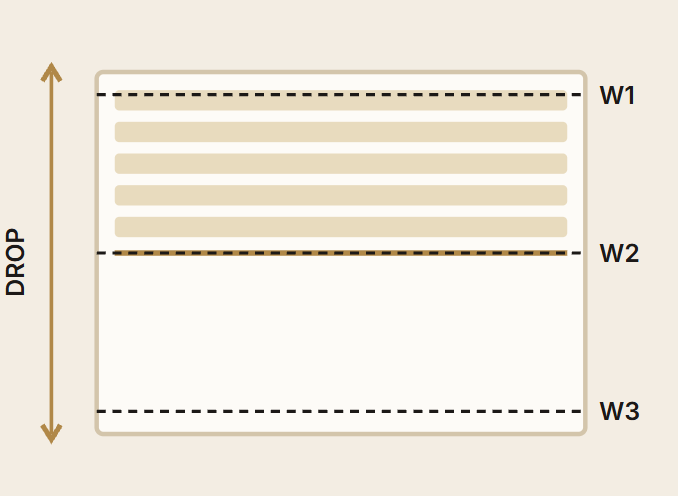
Measure the drop from the top of the recess to the sill, at both edges. Use the larger one.
Do not subtract anything for clearance — tell us the raw opening and we will take off the right amount.
Neat and flush, but a little light always escapes at the edges. Fine for living rooms; not for a blackout bedroom.
Option B
Outside the recess
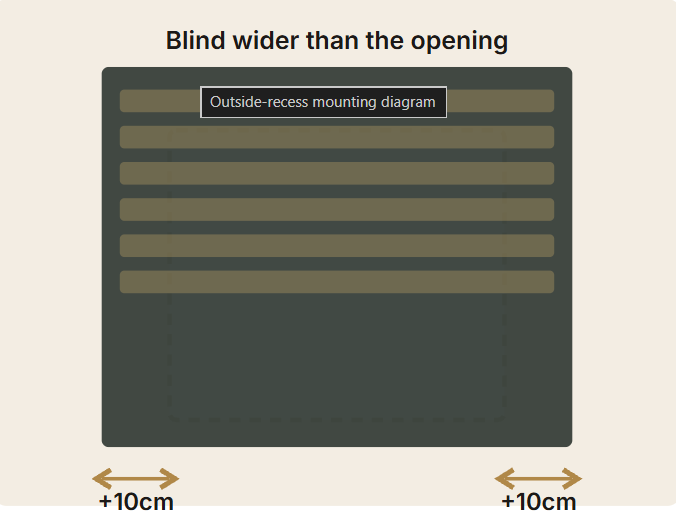
Measure the width of the opening, then add roughly 10 cm on each side
Measure the drop from where the bracket will sit — usually 10 cm above the opening — down past the sill.
Check there is a clear run of wall for the brackets — no AC pipe, no beading in the way.
The overlap is what actually makes a room dark. This is how we fit blackout blinds unless the wall will not allow it.
Rather not measure at all? Send us a photo of the window with anything for scale, and we will bring the tape ourselves. The visit is free whether or not you order.
The three choices you will make
Opacity, operation, mount.
Whichever blind you pick, these are the three decisions that change how it lives in the room.
Opacity
Sheer— softens glare, keeps the view, no privacy after dark
Light-filtering — the everyday choice; bright but private
Blackout— blocks light and cuts afternoon heat
Operation
Bead chain— standard, reliable, child-safety clip included
Spring / cordless — nothing hanging; safest around small children
Motorised— remote or app; needs a power point planned in advance
Mount
Inside recess— flush and tidy, small light gap at the edges
Outside recess — overlaps the opening, makes a room properly dark
Ceiling / track— for wide spans, partitions and balcony doors
Still deciding?
Tell us the room. We will tell you the blind.
Which direction the window faces, what time the sun hits it, and who sleeps there — that is usually enough for us to recommend the right fabric without you visiting the shop.